
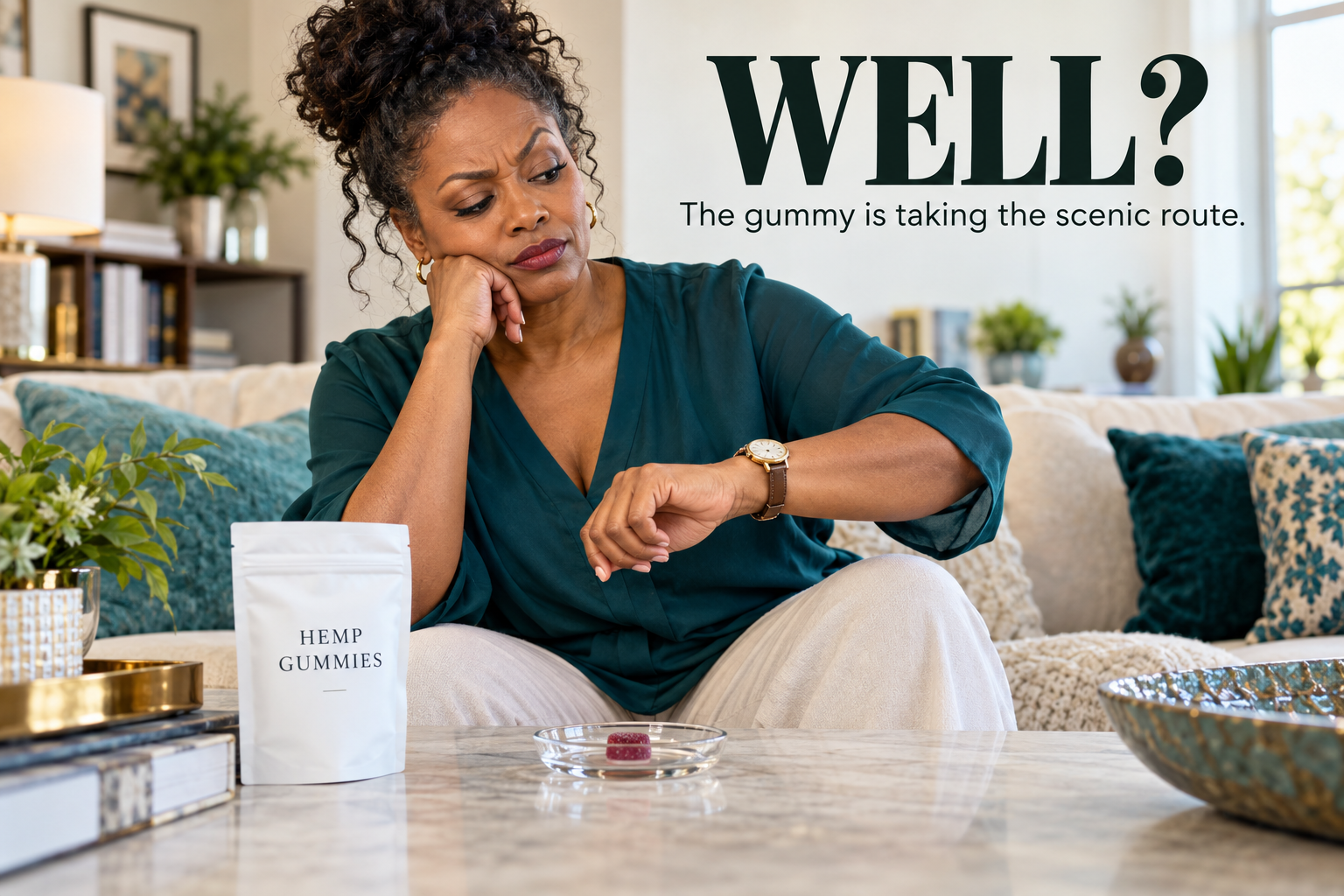
Why do Gummies Take so Long to work?
Why Did That Gummy Take So Long? The Science Behind the Wait
You took a gummy. You settled into your favorite chair. You checked the time.
Twenty minutes later, you checked again.
“Is this thing even working?”
Before you reach for another, your digestive system would like a word.
Unlike ordering a movie, taking an edible does not come with an instant “play” button. There is a journey between swallowing a gummy and feeling its effects—and misunderstanding that journey can turn an ordinary evening into a much longer experience than you planned.
Let’s explore what happens after the chew, why your friend’s experience may look different from yours, and why patience belongs on every edible’s unofficial ingredient list.
One important distinction: the intoxicating effects and timing discussed below primarily concern THC-containing edibles. A CBD-only gummy should not be expected to produce a THC-like high.
Your gummy takes the scenic route
When you swallow a gummy, its ingredients enter your digestive system. Cannabinoids must be released from the product, absorbed, and processed before their effects become apparent.
Oral THC also undergoes substantial processing in the liver before reaching the wider circulation. This is called first-pass metabolism.
Think of it as a delivery with several stops along the way. Swallowing the product starts the journey; it does not mean every active ingredient has already reached its destination.
This helps explain why an edible can feel very different from an inhaled product. The route into your body changes how the substance is absorbed and processed. (accessdata.fda.gov)
So, how long do THC gummies take to kick in?
Health Canada advises that swallowed cannabis can begin producing effects within 30 minutes to two hours, while the full effects may take up to four hours to develop.
Effects can last up to 12 hours, with some residual effects lasting up to 24 hours. These are general ranges, not a personalized countdown or a guarantee that impairment ends at a particular time. (canada.ca)
The most useful distinction is between feeling something and feeling the full effect.
The first noticeable change is not necessarily the strongest point of the experience. Taking another gummy because the first feels subtle can add more THC while the original serving is still taking effect.
Your gummy does not need encouragement. It needs time.
Meet 11-hydroxy-THC: part of the edible story
During processing, your body converts some THC into 11-hydroxy-THC, an active metabolite. “Metabolite” simply means a substance formed as the body processes another substance.
Both THC and this metabolite contribute to the effects of oral THC. That makes the liver part of the experience—not merely a cleanup crew afterward. (accessdata.fda.gov)
This does not mean every edible will feel stronger than every inhaled product. Amount, formulation, and individual response still matter.
It does mean that familiarity with one format does not automatically predict your response to another.
Why your friend’s gummy clock is different
Perhaps your friend says, “Mine always works quickly,” while you are still wondering whether yours has arrived.
Neither experience establishes a universal rule.
The CDC notes that edible effects can vary with the amount consumed, whether someone has eaten, medications, alcohol, and other factors. Delayed effects can also make it easier to consume too much. (cdc.gov)
Here are several reasons the experience can vary.
Food can change the journey
Your meal can affect absorption, but “eat something fatty so it works faster” is an oversimplification.
In a controlled study of prescription oral THC formulations, a high-fat meal changed drug exposure and delayed peak concentrations. That study does not predict exactly what a particular gummy will do, but it shows why food should not be treated as a reliable fast-forward button. (pmc.ncbi.nlm.nih.gov)
The formula matters
Two products can look nearly identical while containing different amounts or combinations of cannabinoids.
A front label reading “25 mg” is incomplete information until you know 25 mg of what—and per what?
Check whether the number describes THC, CBD, a combined cannabinoid amount, one piece, or the whole package.
Comparing products without checking those details is a little like comparing two recipes because both involve a spoon.
Your body brings its own variables
Health history, experience with cannabis, frequency of use, and other substances can influence the response. Even the same person can have different experiences on different occasions. (canada.ca)
A friend’s recommendation can start a conversation. It cannot replace your own product information or professional medical guidance.
The “nothing happened” trap
Here is the classic setup:
You take a gummy. You wait a little. You feel nothing dramatic. You decide the first one must be weak and take another.
Later, both servings become part of the same experience.
This is often called dose stacking: consuming additional amounts before fully understanding the effects of the earlier amount.
The mistake is treating “I don’t feel it yet” as proof that nothing is happening. Public-health guidance specifically warns that taking more during the period when edible effects are still developing increases the risk of adverse effects. (canada.ca)
Allow at least four hours to assess the full effects before even considering more. That is a harm-reduction waiting period, not a guarantee that another serving is appropriate or that you are safe to drive.
Skipping an additional serving is always an option.
Does this apply to CBD gummies, too?
CBD is not intoxicating in the way THC is. If you take a CBD-only product and wait for a traditional cannabis high, you are waiting for the wrong signal.
That does not make CBD free of risks. The FDA identifies potential medication interactions, drowsiness, gastrointestinal effects, and liver injury. Combining it with alcohol or other substances that slow brain activity can increase sedation. (fda.gov)
Also, “hemp gummy” does not automatically mean “CBD-only.” Read the actual cannabinoid content.
If you take medication or are managing a health condition, discuss the specific product with your clinician or pharmacist.
Five habits that make the waiting game less confusing
Read before you chew. Identify the cannabinoids, amount per piece, serving instructions, and warnings.
Write down the time. A quick phone note is more dependable than “I think it was about an hour ago.”
Keep the package. Save the ingredient information and batch details, especially when trying an unfamiliar product.
Leave your schedule flexible. Avoid using an intoxicating edible before driving, operating equipment, or taking responsibility for tasks that require unimpaired judgment.
Store it securely afterward. Keep cannabis products in their original packaging, locked away from children and pets. A gummy’s familiar appearance can make accidental ingestion easier. (canada.ca)
What if the experience becomes uncomfortable?
Stop consuming cannabis and avoid alcohol or additional intoxicants. Stay somewhere safe, do not drive, and have a trusted sober person stay with you if possible.
For guidance about a suspected cannabis poisoning in the United States, call Poison Control at 1-800-222-1222. Call 911 for trouble breathing, a seizure, collapse, or inability to wake someone. Do not assume severe symptoms are simply something to “sleep off.” (cdc.gov, cdc.gov)
Patience is part of understanding the product
A delayed experience does not automatically mean a product is ineffective. A fast experience does not prove a product is better.
The useful questions are more specific: What did I take? How much did it contain? When did I take it? What else could affect my response?
At Durban Dames, we believe those questions deserve clear answers.
Have a question about a gummy label or cannabinoid content? Contact Durban Dames at 678-819-7705 or visit DurbanDames.com for product education.
Because “let me take another and see” is a plot twist your evening may not need.
Durban Dames — Elegantly Elevated.
For adult education only. This article is not medical advice and does not establish a personal dose or guarantee a product’s effects.





Add comment