
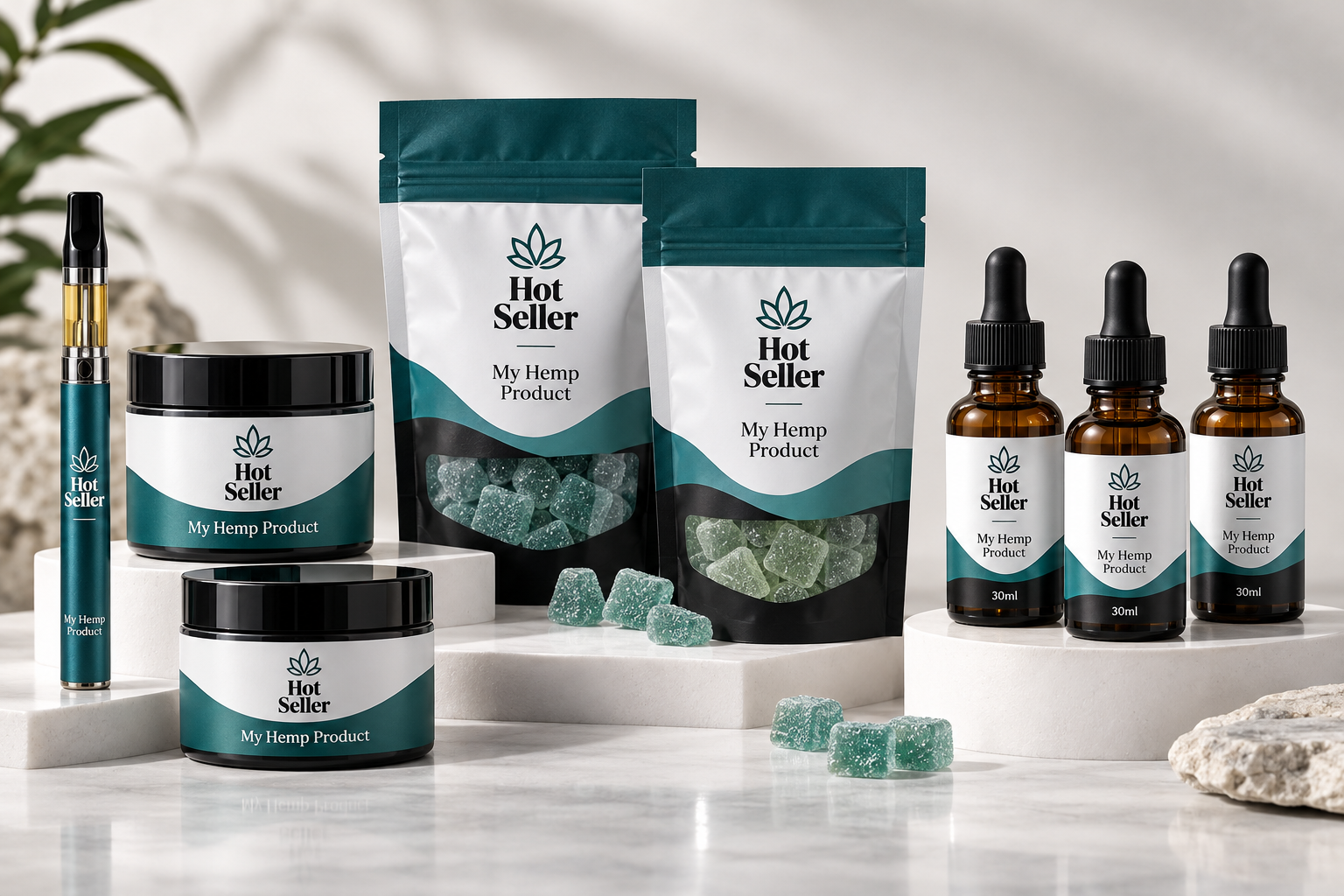
Starting a Hemp Brand?
Want Your Own Hemp Brand? Well, starting a hemp brand can be extremely nuanced. Read This Before Ordering Your First Batch
You have the business name. You can picture the packaging. You may already have customers asking when your products will be available.
Then come the questions that turn an exciting idea into a real business:
Who will manufacture the product? How much inventory should you order? What belongs on the label? And how do you know whether the numbers actually work?
Launching a hemp brand involves more than placing your logo on a package. The decisions you make before production can affect your budget, customer experience, and ability to reorder successfully.
Whether you own a retail shop, operate an established wellness business, or are developing your first brand, a clear starting plan can help you move forward with fewer expensive surprises.
Here are seven steps to take before ordering your first batch.
1. Define the customer before choosing the product
“I want to sell hemp products” is a starting point. It is not yet a product strategy.
A more useful question is: Who already trusts your business, and what do they want to understand or purchase?
An existing retailer has a valuable advantage: customer conversations. Review what people ask about, which formats they already purchase, and what prevents them from buying again.
Do they want clearer ingredient information? A different package size? A product that is easier to carry? More straightforward instructions?
If you are starting without an audience, interview prospective customers before committing to inventory. Ask about their actual purchasing habits rather than whether they like your idea.
Someone saying, “That sounds interesting,” is different from someone explaining what they currently buy, how often they buy it, and what they spend.
Use those answers to write one sentence describing your intended customer and why your product belongs in their shopping routine.
2. Understand white labeling and custom formulation
Manufacturers do not always use these terms consistently, so ask what each service includes.
White labeling generally involves selling an existing product or formula under your own brand. Depending on the provider, you may have choices involving packaging, labeling, or other details.
Custom formulation involves developing or modifying a formula around agreed specifications. That may introduce additional development work, sampling, sourcing, and testing.
Neither approach automatically makes a business more successful. The right choice depends on your customer, budget, timeline, and reason for entering the market.
Before signing an agreement, clarify:
- Whether the formula already exists.
- Which changes are included in the quote.
- Who owns any newly developed formula.
- Whether other brands can sell the same formula.
- What happens if you change manufacturers.
A product carrying your logo is not necessarily an exclusive product. If exclusivity matters to your business, address it in writing.
3. Start with a focused product offering
A broad catalog can feel impressive. It also creates more decisions, more packaging expenses, and more inventory to manage.
For a first launch, consider starting with one clearly defined product, or a small selection supported by evidence from your customers.
Each flavor, strength, size, or format may create another stock-keeping unit, commonly called a SKU. Ask how each variation affects minimum order quantities and production costs.
For example, 100 units divided across several variations may be treated very differently from 100 identical units. Do not assume a manufacturer’s minimum applies across an entire mixed order.
A focused launch also makes your marketing easier. Your team can explain one product thoroughly, answer common questions consistently, and collect useful feedback before adding more.
Your first order should help you learn what customers will purchase again.
4. Calculate the full launch cost
The manufacturing quote is only one part of the budget.
Depending on your agreement, you may also need to account for ingredients, packaging, artwork, labels, testing, shipping, licensing, insurance, payment processing, and marketing.
Ask for an itemized proposal showing what is included, what is separate, and when each payment is due.
Then calculate your margin using realistic selling prices.
Consider this hypothetical example: a product sells for $30 and has a landed cost of $12, including production, packaging, and inbound shipping. That leaves $18 before expenses such as processing fees, advertising, fulfillment, discounts, and overhead.
That $18 is not net profit.
If you also intend to sell wholesale, repeat the calculation using your expected wholesale price. A product that works financially when sold directly to consumers may leave too little room when a retailer needs its own margin.
Build your numbers around the channels you actually plan to use.
5. Discuss testing and labeling before approving packaging
Packaging design should follow the product specifications and applicable requirements.
Ask your manufacturing partner how testing is arranged, which documentation you receive, how batches are identified, and who reviews the finished label.
A certificate of analysis, or COA, reports laboratory results for a tested sample. Learn how to locate the report associated with your product and understand what testing it includes.
For businesses selling in Georgia, the Georgia Department of Agriculture publishes requirements concerning consumable hemp testing and access to COA information. These requirements belong in your launch planning, rather than being treated as paperwork to address afterward.
Also clarify who checks whether your intended product, ingredients, claims, sales channels, and shipping destinations meet applicable requirements.
A manufacturer’s license does not automatically cover every activity your own business intends to perform. Likewise, meeting one state’s requirements does not settle every federal or destination-state question.
Verify the rules that apply to your specific plan before production and sale.
6. Evaluate the relationship behind the quote
Price matters. So does your ability to get a clear answer when something changes.
Before choosing a partner, discuss the practical details:
- How samples are approved.
- When the production timeline begins.
- Which circumstances can delay delivery.
- How formula or packaging changes are handled.
- What happens if a batch fails an agreed specification.
- Who handles damaged goods or quality complaints.
- What a reorder requires.
Put important expectations into the agreement.
Also ask what happens if a raw material becomes unavailable. Will substitutions require your approval? Could they affect the label, testing, price, or customer experience?
A useful manufacturing conversation should leave both parties with the same understanding of the product and responsibilities.
The goal is a working relationship that can support your second and third orders as thoughtfully as your first.
7. Plan the sale before the shipment arrives
Finished inventory needs a route to customers.
Before your launch, prepare a clear product page, accurate photographs, an explanation of the product, and a way for interested customers to contact you.
For wholesale sales, create a simple retailer information sheet covering pricing, order quantities, product details, and ordering instructions.
Train anyone who will answer customer questions. They should understand the label and available documentation, avoid unsupported medical promises, and know when a question belongs with a healthcare professional.
Finally, define what you will measure.
Track units sold, actual selling price, customer questions, returns, and repeat purchases. Those details give you a stronger basis for your next order than social media likes alone.
Starting your hemp brand with a clear first step
You do not need every product or every answer on day one. You need a defined customer, workable numbers, and clear expectations with the people helping you produce your first batch.
Durban Dames helps businesses explore white-label manufacturing, formulation guidance, sourcing, production coordination, and packaging considerations, with the scope established for each project.
Already own a business? Tell us what your customers are requesting.
Starting something new? Bring your product idea, intended market, estimated quantity, and budget. Those details help make the first conversation productive.
Ready to explore a product under your own brand?
Contact Durban Dames at 678-819-7705 or visit B2B.DurbanDames.com/. Mention “WHITE LABEL” and tell us what you would like to create.
Durban Dames — Elegantly Elevated.
This article provides general business education, not legal or medical advice. Requirements vary by product, activity, and location.
Reference: Georgia Department of Agriculture — Consumable Hemp Retail Licensing, Testing, and Labeling Information
Starting a hemp brand. Contact Durban Dames to Start your hemp or cannabis brand today!
Add comment