
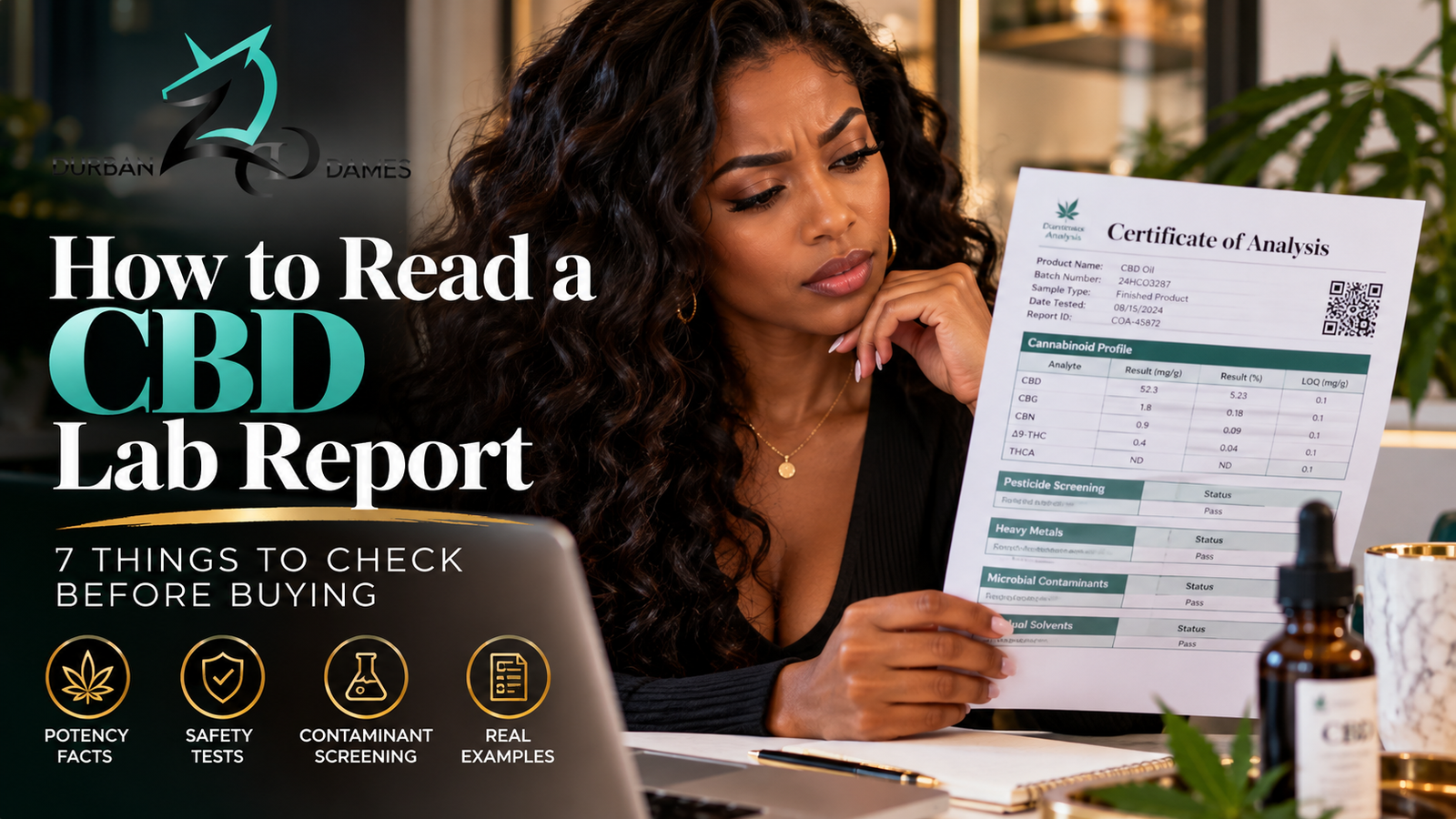
How to read a CBD Lab Report: 7 Things to Check Before Buying Hemp Products
Your CBD product may say “premium,” “pure,” or “lab tested.” But can you actually prove what’s inside it?
The answer may be hiding in a document most consumers have never read: the Certificate of Analysis.
As hemp wellness products become increasingly popular, consumers are asking smarter questions. How much CBD is really in that gummy? Does a full-spectrum oil contain THC? Were the ingredients tested for heavy metals or pesticides?
Whether you’re shopping for yourself or developing products for your own hemp business, knowing how to read a CBD lab report is one of the most valuable skills you can learn.
At Durban Dames, we believe beautiful packaging should be supported by transparent product information.
Here’s how to look beyond the label.
What Is a CBD Certificate of Analysis (COA)?
A Certificate of Analysis, commonly called a COA, is a laboratory report documenting the results of specific tests performed on a product or sample.
In the hemp industry, COAs may report cannabinoid potency, microbial contamination, pesticides, heavy metals, residual solvents, and other quality indicators.
But here’s something many consumers don’t realize:
A COA does not automatically mean a product is safe, compliant, or accurately labeled.
Its usefulness depends on what was tested, how the sample was collected, the laboratory’s methods, and whether the results actually correspond to the product you’re purchasing.
A report that measures CBD and THC potency alone cannot tell you whether a product was screened for heavy metals.
That’s why knowing how to interpret the document matters.
1. Verify the Laboratory and Its Credentials
Start at the top of the report.
Look for the laboratory’s name, contact information, report date, and accreditation details.
Many reputable cannabis-testing laboratories maintain ISO/IEC 17025 accreditation for specific testing methods.
However, accreditation is not a universal guarantee that every test offered by a laboratory is covered by its accredited scope.
If a report claims accreditation, you can often verify that information with the laboratory’s accreditation body.
Also consider whether the testing laboratory is independent of the product manufacturer.
Independent testing can provide an additional layer of accountability, although sampling practices and conflicts of interest still matter.
Consumer tip: A legitimate COA should identify a real laboratory that you can contact or independently verify.
2. Match the Batch Number to Your Product
This is one of the most important steps, yet it’s frequently overlooked.
Imagine purchasing a bottle of CBD oil manufactured in September but receiving a laboratory report for a batch produced six months earlier.
Even if that earlier report looks excellent, it may not tell you what is inside your particular bottle.
Look for the batch or lot number on your product packaging.
Then compare it with the batch or sample identification on the COA.
Ideally, they should match or be clearly traceable through the manufacturer’s records.
Also check the sample collection, receipt, and testing dates when available.
A newer report is not necessarily better if it belongs to the wrong product or batch.
Consumer tip: If a company cannot explain how its COA relates to your product, ask for clarification before purchasing.
3. Understand CBD and THC Potency Results
This is where the chemistry gets interesting.
A cannabinoid potency panel identifies which cannabinoids were detected and their reported concentrations.
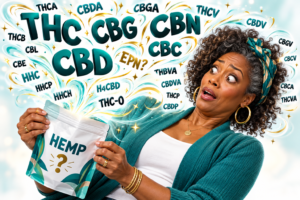
Common cannabinoids include:
● CBD — cannabidiol
● THC — tetrahydrocannabinol
● CBDA — cannabidiolic acid
● THCA — tetrahydrocannabinolic acid
● CBG — cannabigerol
● CBN — cannabinol
Results may be expressed as milligrams per gram (mg/g), milligrams per milliliter (mg/mL), percentages by weight, or estimated milligrams per serving.
These units are not interchangeable.
Understanding Percentages
For a product measured by weight, 1% represents approximately 10 milligrams per gram.
For example, if a sample contains 5% CBD by weight:
5% × 1,000 mg = 50 mg of CBD per gram of product.
However, a liquid product’s total CBD content cannot always be calculated accurately from its volume without knowing the density and the units used in the laboratory report.
Understanding Total THC
Some reports list both delta-9 THC and THCA.
A commonly used calculation for potential total THC is:
Total THC = Delta-9 THC + (THCA × 0.877)
The 0.877 factor accounts for the difference in molecular weight when THCA converts to THC through decarboxylation.
However, legal definitions and testing requirements vary by jurisdiction and product category.
A product meeting one THC threshold does not necessarily satisfy every applicable federal or state requirement.
Consumer tip: Always check the units and the specific cannabinoids measured rather than relying on a single number labeled “total cannabinoids.”
4. Look for Heavy Metal Testing
Cannabis plants can absorb certain substances from their growing environment, including metals present in soil and water.
Depending on the product and applicable testing requirements, laboratories may evaluate contaminants such as:
● Lead
● Cadmium
● Arsenic
● Mercury
Heavy metals can present health risks, particularly with repeated exposure.
A report may show results in parts per million (ppm), parts per billion (ppb), or other concentration units.
But a number alone doesn’t tell the full story.
You need to know the relevant testing limit, the laboratory’s detection or quantitation limits, and whether the result complies with applicable requirements.
For example, a result marked ND typically means not detected at the laboratory’s stated detection limit.
It does not necessarily mean the substance is completely absent.
Consumer tip: Look for an actual contaminant-testing panel and its reported limits—not simply the phrase “heavy-metal tested.”
5. Check for Pesticides and Residual Solvents
Hemp cultivation and cannabinoid extraction can introduce different quality-control concerns.
Pesticide Testing
Depending on the agricultural practices used, plant material may contain residues of pesticides or other agricultural chemicals.
Laboratories may test for a defined list of compounds.
However, no single pesticide panel necessarily tests for every possible chemical.
Residual Solvent Testing
Certain extraction and manufacturing processes use solvents.
When relevant, testing may evaluate residual compounds such as ethanol, butane, propane, or other solvents.
Not every product is manufactured using the same extraction method.
A solvent-testing result should therefore be interpreted in the context of the manufacturing process and applicable standards.
Consumer tip: Ask which contaminants were tested and whether the panel is appropriate for the product type.
6. Don’t Ignore Microbial Testing
Microorganisms are another important consideration, particularly for products that contain botanical ingredients or are manufactured under conditions where contamination is possible.
Depending on the product, laboratories may screen for:
● Certain bacteria
● Yeast and mold
● Specific pathogenic microorganisms
● Mycotoxins produced by some molds
Microbial testing is especially important because contamination may not be visible or detectable by smell.
An attractive product can still have a quality problem.
But remember, a passing microbial report is only evidence about the sample and tests performed. It does not guarantee that every unit in a batch is free of contamination.
Good manufacturing practices, sanitation, packaging, and storage remain essential.
7. Compare the COA With the Product Label
Now comes the final—and often most revealing—step.
Does the laboratory report support the information printed on the packaging?
Suppose a package contains 10 gummies and claims 25 mg of CBD per gummy.
That represents a labeled total of:
10 gummies × 25 mg = 250 mg CBD per package.
The laboratory report should provide sufficient information to evaluate whether the tested product is consistent with that claim.
But interpretation depends on how the sample was tested.
A laboratory might report CBD concentration per gram of homogenized product rather than per gummy.
In that case, you would need additional information, such as the average weight of each gummy, to calculate the amount per serving.
Testing uncertainty and permitted labeling tolerances may also apply.
A small difference between a label and a test result is not automatically evidence of fraud. A large unexplained discrepancy deserves further investigation.
Consumer tip: Be especially cautious when a manufacturer advertises precise cannabinoid quantities but cannot provide a relevant potency report.
What Does “Full-Spectrum” Really Mean on a COA?
Full-spectrum CBD products generally contain a range of naturally occurring hemp compounds and may include measurable THC.
Broad-spectrum products generally contain multiple cannabinoids with THC reduced or removed.
CBD isolate products contain highly purified cannabidiol.
These are common industry descriptions, but the words themselves do not establish the precise chemical composition of a finished product.
A COA can help you investigate what is actually present.
For example, a full-spectrum product might show CBD alongside smaller quantities of CBG, CBN, or THC.
A product marketed as THC-free should be evaluated carefully against the laboratory’s detection limits and actual findings.
Consumers subject to workplace drug testing should be particularly cautious because some hemp products contain THC.
Can You Trust a QR Code on CBD Packaging?
QR codes are convenient, but they’re only as useful as the information they provide.
A QR code might direct you to a laboratory report, a manufacturer’s website, or a general product-information page.
Before trusting the information, verify that the linked report identifies the laboratory, product, batch, and relevant tests.
A QR code that opens a generic marketing page is not equivalent to a batch-specific laboratory report.
Likewise, a professional-looking PDF is not proof that the underlying test results are authentic.
When necessary, contact the testing laboratory to verify the report.
Why This Matters for Hemp Business Owners
If you’re planning to launch a hemp wellness brand, understanding COAs is more than a consumer education exercise.
It’s an important part of responsible product development.
Retailers, manufacturers, and white-label businesses need to consider ingredient specifications, finished-product testing, labeling accuracy, traceability, and applicable regulatory requirements.
A certificate for raw CBD distillate does not necessarily establish the potency or safety of a finished gummy, beverage, or topical product.
Manufacturing can introduce additional variables.
Ingredients are mixed, heated, packaged, stored, and sometimes combined with other cannabinoids.
Each stage creates potential quality-control considerations.
That’s why a responsible manufacturing process should include appropriate specifications, documentation, and testing decisions based on the finished product.
Thinking About Launching Your Own Hemp Brand?
Durban Dames offers white-label manufacturing and consulting services for entrepreneurs and businesses entering or expanding within the hemp industry.
Our services include formulation guidance, raw-material sourcing support, production coordination, packaging guidance, and product-launch education.
We also help clients understand the questions they should ask when evaluating laboratory documentation and manufacturing partners.
Testing costs, regulatory requirements, and the scope of manufacturing services depend on the product and project.
Interested in creating your own hemp wellness product?
Visit DurbanDames.com to learn more about our manufacturing and consulting services and inquire about a product-development consultation.
Frequently Asked Questions
What does COA stand for in CBD products?
COA stands for Certificate of Analysis. It is a laboratory document reporting the results of specific tests performed on a product or sample.
Does a COA guarantee a CBD product is safe?
No. A COA provides information about the tests performed on a particular sample. It does not guarantee that every potential contaminant was tested or that every unit of a product is safe.
What does ND mean on a CBD lab report?
ND generally means “not detected” at the laboratory’s stated detection limit. It does not necessarily mean a substance is completely absent.
How do I know if my CBD contains THC?
Review the cannabinoid potency panel on the relevant COA. Check for delta-9 THC and other THC-related compounds, along with the units and detection limits.
Should CBD gummies have a lab report?
Consumers should look for relevant, reliable testing information that supports cannabinoid labeling and appropriate quality-control claims. The precise testing obligations depend on the jurisdiction and product.
Is a raw-material COA enough for a finished hemp product?
Not necessarily. A raw-material COA describes the tested ingredient, not automatically the finished product. Processing and additional ingredients can affect finished-product quality.
Final Thoughts: Don’t Just Read the Label. Read the Evidence.
The hemp wellness industry continues to evolve, and informed consumers have more questions than ever.
That’s a positive development.
A Certificate of Analysis can reveal valuable information about cannabinoid content and product quality—but only when you understand what you’re looking at.
Before your next hemp purchase, take a few minutes to investigate the laboratory report.
Verify the batch number. Check the cannabinoid content. Review contaminant testing. Compare the results with the label.
And remember: transparency should be part of the product experience, not an afterthought.
At Durban Dames, we believe that educated consumers and responsible manufacturers help build a stronger hemp industry.
Elegantly Elevated. Peace. Power. Pleasure.
Durban Dames — Hemp Wellness, Manufacturing & Education
Sources and Further Reading
● FDA — Regulation of Cannabis and Cannabis-Derived Products
● FDA — What You Need to Know About CBD Products
● NIST — Cannabis and Hemp Research
● ISO — ISO/IEC 17025 Testing and Calibration Laboratories
Disclaimer: This article is provided for educational purposes and is not legal, medical, or regulatory compliance advice. Hemp laws, testing requirements, and labeling rules vary by jurisdiction and product category. Consult qualified professionals regarding your specific products and business operations.
One comment
Pingback:
Cannabinoids Chart: Natural, Synthetic & EPN Explained