
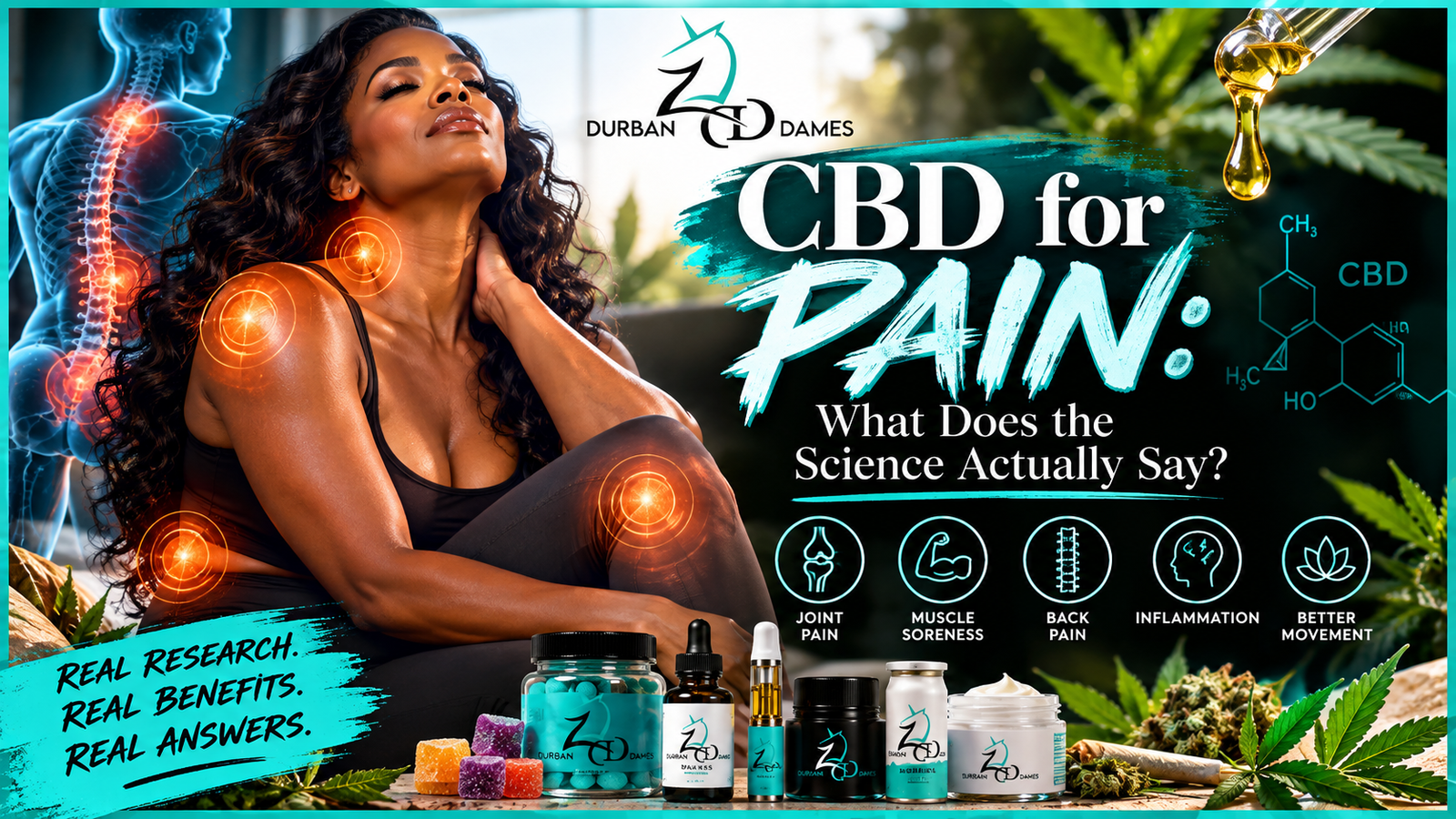
CBD for Pain: Does It Really Work? What Science Reveals
Millions of people are searching for natural pain relief. CBD has become one of the most popular options—but is it backed by science, or are consumers buying into clever marketing?
Imagine waking up in the morning and feeling stiff before your feet even touch the floor. Your knees ache, your back feels tight, or your shoulders remind you of yesterday’s activities.
For many adults, especially those managing chronic discomfort, pain isn’t an occasional inconvenience. It’s part of everyday life.
This has fueled enormous interest in cannabidiol, better known as CBD.
From CBD gummies and tinctures to topical creams and balms, hemp-derived products are increasingly marketed to people seeking relief from sore muscles, joint discomfort, and persistent pain.
But there’s an important question:
Does CBD actually relieve pain, or does the marketing promise more than the science can deliver?
At Durban Dames, we believe consumers deserve facts, not exaggerated promises.
Let’s explore what researchers know, what remains uncertain, and how to make informed decisions about hemp wellness products.
What Is CBD, and Why Are Scientists Studying It?
Cannabidiol (CBD) is one of more than 100 cannabinoids identified in the cannabis plant.
Unlike THC, CBD does not typically produce the intoxicating high associated with cannabis.
Researchers are interested in CBD because it interacts with several biological signaling pathways involved in processes such as inflammation, stress responses, and pain perception.
One of the systems being investigated is the body’s endocannabinoid system.
Your Body Has Its Own Cannabinoid Signaling System
The endocannabinoid system, or ECS, helps regulate several physiological functions, including appetite, mood, memory, and aspects of pain signaling.
It consists of naturally produced molecules called endocannabinoids, cannabinoid receptors, and enzymes that regulate those molecules.
The two best-known cannabinoid receptors are CB1 and CB2.
CB1 receptors are especially abundant in the nervous system, while CB2 receptors are found in many immune-related tissues.
CBD’s pharmacology is complex. Unlike THC, it does not primarily act by directly activating CB1 receptors.
Instead, CBD influences multiple molecular targets that scientists continue to study.
These mechanisms make CBD an interesting research subject. However, biological activity in a laboratory does not automatically translate into meaningful pain relief in humans.
That’s where clinical trials become essential.
What Does Scientific Research Actually Say About CBD for Pain?
Some cannabis-based medications and formulations have shown modest benefits for certain chronic pain conditions.
However, evidence about cannabis products containing THC cannot automatically be applied to CBD-only products.
This distinction is frequently overlooked in marketing.
CBD-Only Products Have Limited Evidence for Pain Relief
A major 2024 review published in the Journal of Pain examined the evidence surrounding CBD products and pain.
The researchers reported that many CBD products marketed for pain lack strong evidence of effectiveness.
In randomized trials of CBD-only products, results have often failed to show meaningful pain relief compared with placebo.
This does not prove CBD could never be useful for any pain-related condition. It means the current evidence does not establish CBD as an effective general pain treatment.
What About Products Containing THC?
Research involving certain THC-containing cannabis products has produced somewhat different results.
A 2023 systematic review published in BMJ examined non-inhaled medical cannabis and cannabinoids for chronic pain.
The authors found that some products were associated with small improvements in pain and sleep outcomes.
However, benefits were generally modest, and adverse effects—including dizziness and sedation—were more common.
The important lesson is that cannabinoid composition matters.
A THC-containing product, a CBD-only tincture, and a topical hemp balm are not interchangeable simply because they originate from the same plant.
Can CBD Reduce Inflammation?
Inflammation is part of the body’s natural defense system.
When you injure a muscle or develop an infection, inflammatory processes help the body respond.
Problems can arise when inflammation becomes excessive or persistent.
Researchers have investigated CBD’s anti-inflammatory activity in laboratory and animal studies.
Some experiments suggest CBD may influence inflammatory signaling pathways and immune responses.
However, findings from laboratory experiments are not sufficient to establish that taking a CBD gummy or applying a CBD cream will reduce inflammation in a person.
The human evidence remains limited.
CBD has demonstrated biological activity worth investigating, but it is not an established treatment for inflammatory diseases.
CBD for Arthritis: What Should Consumers Know?
Arthritis is a common reason people investigate CBD.
Osteoarthritis, for example, can cause joint pain, stiffness, and reduced mobility.
Some consumers report that CBD products help them feel more comfortable.
A randomized controlled trial examining oral CBD for painful hand osteoarthritis and psoriatic arthritis did not find a statistically significant reduction in pain compared with placebo.
This finding is important because it demonstrates why controlled studies matter.
A product may be popular and still fail to outperform placebo in a clinical trial.
People living with arthritis should work with their healthcare professionals to develop an evidence-based management plan that may include exercise, physical therapy, appropriate medications, and other interventions.
What About CBD Creams for Muscle and Joint Discomfort?
Topical CBD products are particularly popular among adults interested in massage, recovery, and localized wellness routines.
They may contain ingredients such as shea butter, coconut oil, menthol, botanical extracts, or other skin-conditioning compounds.
However, the evidence supporting topical CBD specifically for pain remains preliminary.
Another important distinction is the difference between topical and transdermal products. Durban Dames’ topical cream is both a topical and transdermal because both are required to penetrate and dull pain at a particular location.
A conventional topical is generally intended for application to the skin. A transdermal formulation is designed to deliver ingredients across the skin barrier.
These products should not be assumed to have the same absorption or effects.
Consumers should also avoid applying products to broken or irritated skin unless the labeling specifically supports that use.
CBD Gummies vs. Oils vs. Topicals: What’s the Difference?
Understanding product formats is important when researching cannabinoids.
CBD Gummies
Gummies are edible products containing measured quantities of cannabinoids.
They are convenient and familiar to many consumers, but their absorption can vary with food intake, formulation, and individual metabolism.
Because effects may be delayed, taking additional servings too quickly can increase the risk of unwanted effects.
CBD Oils and Tinctures
CBD oils allow consumers to measure liquid servings using a dropper or another dosing device.
Some are swallowed, while others are designed for use under the tongue.
Absorption varies depending on formulation and how the product is used.
CBD Topicals
Creams, balms, and lotions are applied directly to the skin.
They are often incorporated into massage or self-care routines.
The amount of CBD that reaches deeper tissues through ordinary topical application is uncertain and depends on the formulation.
No product format has been established as universally superior for treating pain.
The appropriate choice depends on the product’s intended use, ingredients, safety profile, and the consumer’s circumstances.
Full-Spectrum vs. Broad-Spectrum vs. CBD Isolate
These terms appear frequently on hemp product labels.
Full-spectrum hemp extracts generally contain multiple naturally occurring hemp compounds and may include THC.
Broad-spectrum extracts generally contain multiple cannabinoids with THC removed or reduced, although consumers should verify the laboratory results rather than assume a product is completely THC-free.
CBD isolate is a highly purified form of cannabidiol.
Some marketers claim that combining cannabinoids creates an enhanced effect commonly called the entourage effect.
Although interactions among cannabis compounds are a legitimate area of scientific investigation, evidence does not establish that every full-spectrum product works better than isolated CBD.
More cannabinoids do not automatically mean better outcomes.
The actual composition, formulation, and supporting evidence are more important than the marketing label.
Five Things to Check Before Buying a CBD Product
Consumers should evaluate hemp products with the same care they would apply to other wellness purchases.
1. Look for Independent Laboratory Testing
A Certificate of Analysis (COA) can provide information about cannabinoid content.
Depending on the testing performed, it may also report pesticides, heavy metals, residual solvents, and microbial contaminants.
2. Verify the Amount of CBD
Check whether the listed milligrams refer to the entire container or an individual serving.
A bottle labeled 1,000 mg does not necessarily contain 1,000 mg per serving.
3. Check for THC
Some hemp-derived products contain THC even when marketed primarily as CBD products.
THC may cause impairment and can affect drug-testing results.
4. Be Skeptical of Miracle Claims
Claims that CBD cures arthritis, eliminates chronic pain, or treats serious diseases should raise concerns.
The current scientific evidence does not justify those promises.
5. Consider Medication Interactions
CBD can affect how certain medications are processed by the body.
It may also cause side effects such as drowsiness, diarrhea, and changes in appetite.
The FDA has warned about potential liver injury and drug interactions.
Anyone taking prescription medication, particularly medications with important interaction risks, should consult a qualified healthcare professional before using CBD.
Pregnant or breastfeeding individuals should avoid CBD.
Why Product Quality Matters in the Hemp Industry
The hemp market includes products manufactured under very different conditions.
Two products with similar labels may have substantially different cannabinoid concentrations, ingredients, and quality-control practices.
This is why transparency is essential.
At Durban Dames, we believe that understanding product formulation, sourcing, testing, and manufacturing should be part of the consumer experience.
A beautiful package may attract attention, but responsible product information is what helps consumers make educated choices.
We encourage customers to ask questions about cannabinoids, ingredient selection, laboratory testing, and intended product use.
For consumers exploring hemp wellness, education should always come before expectations.
What Else Can Help With Chronic Pain?
Pain is complex.
It can involve tissue injury, inflammation, nerve signaling, emotional stress, sleep disturbances, and other health conditions.
Consequently, effective pain management often requires more than a single intervention.
Depending on the underlying cause, evidence-based approaches may include physical therapy, appropriate exercise, behavioral therapies, medication, and medical evaluation.
Sleep quality and stress management can also influence how people experience persistent pain.
If pain is worsening, interfering with daily activities, or accompanied by symptoms such as weakness, fever, or new neurological changes, professional medical assessment is important.
Frequently Asked Questions About CBD and Pain
Does CBD actually work for chronic pain?
Current clinical evidence does not establish that CBD-only products reliably relieve chronic pain. Some THC-containing cannabis formulations have shown modest benefits for certain conditions, but those findings should not be attributed to CBD alone.
Is CBD an anti-inflammatory?
CBD has shown anti-inflammatory activity in some laboratory and animal studies. More human clinical research is needed to establish whether it meaningfully reduces inflammation in people.
Can CBD help arthritis?
Evidence is insufficient to recommend CBD as an established arthritis treatment. Some controlled trials have not demonstrated significant pain improvements over placebo.
Which is better for pain: CBD oil or gummies?
There is insufficient evidence to conclude that either format is consistently more effective for pain. Formulation, absorption, ingredients, and individual circumstances differ.
Can you take CBD with prescription pain medication?
CBD may interact with certain medications. Consult your prescribing clinician or pharmacist before combining CBD with prescription pain medicines or other medications.
Does more CBD mean stronger pain relief?
Not necessarily. Clinical research has not established a universal CBD dose for treating pain, and higher amounts can increase the risk of adverse effects.
Final Thoughts: Science Before the Sales Pitch
CBD is a fascinating cannabinoid, and research into its biological effects continues.
But consumers deserve a clear distinction between scientific potential and proven clinical benefits.
The current evidence does not support presenting CBD as a reliable treatment for chronic pain, arthritis, or inflammation.
That doesn’t make cannabinoid research unimportant. It makes responsible education even more valuable.
At Durban Dames, our commitment is to help consumers understand the cannabis plant, ask better questions, and make informed wellness decisions.
Because true wellness begins with knowledge.
Peace. Power. Pleasure.
Durban Dames — Elegantly Elevated Hemp & Cannabis Wellness
Explore more cannabinoid education and hemp wellness products at DurbanDames.com.
⸻
Scientific References and Further Reading
- National Center for Complementary and Integrative Health — Cannabis and Cannabinoids: What You Need to Know
- FDA — What You Need to Know About Products Containing CBD
- International Association for the Study of Pain — IASP Position Statement on Cannabinoids for Pain
- PubMed — Research on CBD and Pain
- PubMed — Systematic Reviews of Cannabis and Chronic Pain
Medical disclaimer: This article is for educational purposes only and does not constitute medical advice. Durban Dames does not claim that CBD products diagnose, treat, cure, or prevent disease. Consult a qualified healthcare professional about persistent pain, medication interactions, or cannabinoid use.





Add comment